What Happens When NASA’s $30 Million Toilet Malfunctions in Space?
Space travel sounds like clean science and smooth systems, but reality has a way of getting messy. Artemis II, marking humanity’s return to deep space after more than five decades, encountered a problem that nobody can ignore. The brand-new toilet on board Orion broke down shortly after launch, and suddenly four highly trained astronauts had to deal with something very human.
The mission marked a huge step forward for space exploration, yet it also proved that even advanced technology can fail in the most basic ways. When the toilet stopped working as expected, the crew had no choice but to improvise, troubleshoot, and fall back on backup systems that felt closer to the past than the future.
The High-Tech Toilet Didn’t Cooperate

NASA / IG /Astronaut Christina Koch, one of the mission specialists, even had to take on the role of “space plumber” to address the recurring toilet issues.
NASA designed the Universal Waste Management System to be smarter, cleaner, and easier to use than anything that came before. This system used airflow and vacuum pressure to guide waste into the right containers, which sounds simple until you remember that nothing behaves normally in zero gravity.
Soon after launch on April 1, 2026, a fault light appeared, pointing to a controller issue in the urine system. Engineers on the ground helped the crew reset it, and for a moment, things seemed fine. Then another issue showed up, and this one was harder to ignore.
A vent line was clogged, likely because ice formed inside it. That blockage stopped waste from being released into space, which meant the system could not complete its job. NASA came up with a creative fix and asked the crew to rotate the spacecraft so sunlight could warm the vent and melt the ice.
Astronaut Christina Koch stepped into an unexpected role during all of this. She helped manage the issue directly, earning the nickname “space plumber.” It sounds funny, but the situation was serious and needed quick thinking to avoid bigger problems.
Why Space Bathrooms Are Still So Hard to Build
It might seem strange that modern spacecraft still struggle with something as basic as a toilet. The truth is that microgravity changes everything. On Earth, gravity does most of the work, but in space, engineers have to replace that force with airflow and careful design.
Even small design flaws can cause big issues once the system is in use. Liquids float, solids drift, and temperature changes can freeze parts that must stay clear. A simple clog in space becomes a mission concern, not just a maintenance issue.
Looking back at Apollo missions helps explain how far things have come, and also how tricky this problem has always been. Astronauts in the 1960s had no real toilets at all. They relied on tubes and bags, which were awkward, messy, and sometimes failed in embarrassing ways.
The Artemis II toilet was supposed to fix all those old problems. It was built using advanced materials, including 3D-printed titanium, and designed to handle both urine and solid waste at the same time. That design made it more practical for mixed crews, including women, which earlier systems did not fully support.
Backup Plans and Daily Routines in Space
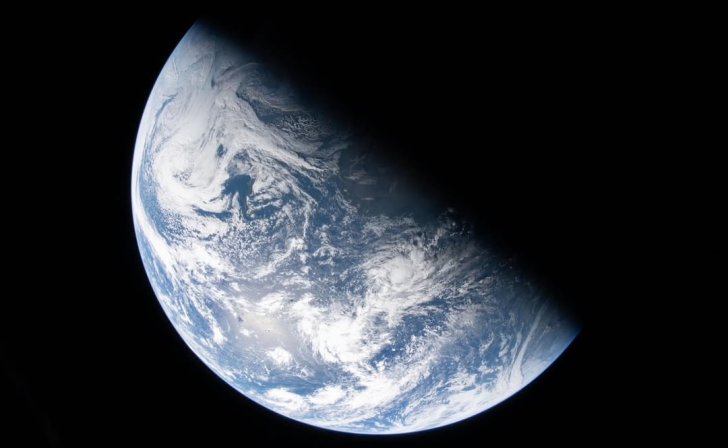
NASA / IG / (One of the “spectacular” images of Earth coming from the Artemis II crew.) NASA planned the mission as a ten-day flight, which meant it did not include the complex recycling systems used on the International Space Station.
Instead, the crew followed a simpler routine that involved storing solid waste and venting urine into space.
The venting process had to happen carefully, and the clog made that routine harder to manage. Engineers worked closely with the crew to keep everything functioning, adjusting procedures as needed to avoid further buildup or damage.
John Honeycutt, who leads the mission management team, acknowledged that people focus on this issue for a reason. It connects advanced science with everyday life, showing that even astronauts deal with basic needs under extreme conditions.