Ancient Humans Were Master Toolmakers? New Study Unearths 500,000-YO Elephant Bone Hammer
Ancient humans continue to surprise scientists with their remarkable skills. A newly analyzed elephant bone tool from southern England has revealed that early humans were far more inventive than many people once believed. The discovery pushes back the timeline for the development of advanced bone-tool technology in Europe by hundreds of thousands of years.
The artifact dates to around 500,000 years ago and comes from the famous Boxgrove archaeological site in West Sussex. Researchers recently took another look at the forgotten bone fragment using modern imaging techniques. What they found has changed the story of prehistoric toolmaking and offered fresh clues about the minds of our distant ancestors.
A Forgotten Bone Reveals an Extraordinary Story
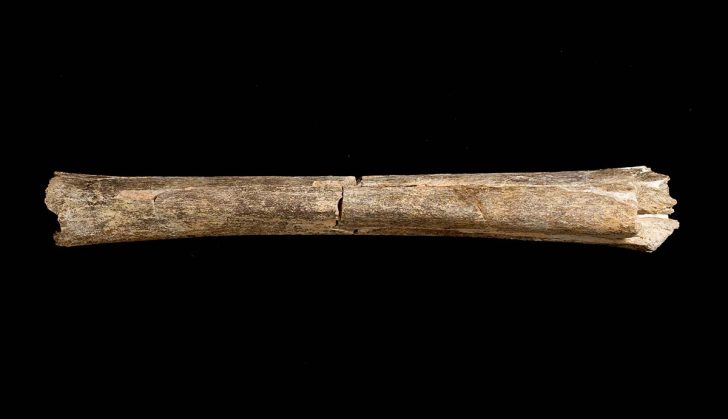
E Online / The elephant bone fragment was first uncovered during excavations at Boxgrove in the early 1990s.
At first glance, it looked like another broken piece of animal remains. Scientists stored it away while attention focused on the site’s famous stone tools and ancient human fossils.
Everything changed when researchers from University College London and the Natural History Museum examined it with high-resolution 3D scanning and electron microscopy. They spotted carefully shaped notches, repeated impact marks, and tiny pieces of flint trapped inside the bone. These signs confirmed that ancient humans had deliberately shaped and repeatedly used the object as a specialized tool.
The bone itself measures about 11 centimeters long, 6 centimeters wide, and 3 centimeters thick. Its triangular shape was not random. The edges and worn surfaces show clear evidence of careful handling over an extended period.
Why an Elephant Bone Made the Perfect Hammer?
The tool served as what archaeologists call a soft hammer or retoucher. This was not a hammer for smashing rocks apart. Instead, it was designed for a much more careful job. Early humans used it to reshape stone handaxes after their cutting edges became dull.
A softer hammer made from dense bone allowed skilled toolmakers to remove tiny flakes from a stone edge with much greater control. That process sharpened the blade while preserving its overall shape. It demanded patience, steady hands, and a clear understanding of how stone breaks under pressure.
Elephant bone was especially useful because of its thick outer layer, known as cortical bone. It was dense enough to survive repeated strikes without shattering. Bones from smaller animals would have worn out much faster under the same conditions.
This choice of material also shows that ancient humans understood the strengths of different natural resources. They selected a material suited to the task and then shaped it into a reliable working tool.
Smart Planning Long Before Modern Humans
Sreej / Pexels / The people who crafted this hammer were probably Homo heidelbergensis or very early Neanderthals. Homo heidelbergensis is widely considered a common ancestor of both Neanderthals and modern humans.
These ancient populations lived hundreds of thousands of years before our own species appeared.
Their actions reveal careful planning rather than simple survival. Elephants and mammoths were not common sights in prehistoric Britain. Finding one would have been a rare opportunity. Instead of using only the meat, these early humans recognized the value of its massive bones and saved them for future work.
That decision required more than practical thinking. It showed foresight. They understood that certain materials had lasting value and could improve other tools they depended on every day.
One reason this discovery matters so much is that the bone sat unnoticed for decades. Earlier researchers lacked today’s powerful imaging technology, making it much harder to identify subtle signs of tool use.
Modern scanning techniques revealed microscopic damage patterns that were invisible during the original excavation. Embedded flint fragments provided another important clue because they matched the repeated strikes expected from sharpening stone tools. Without these advanced methods, the artifact might still be sitting in storage without anyone recognizing its true purpose.